Tuesday, February 28, 2012

Jussieu Campus / Institut du Monde Arab

The Jussieu Campus looks like one of those projects a student might put up on a wall that would create a conversation which assumes it would never be built and is more about an idea of architecture. Well, it's built. It's in Paris, and it's generally considered a failure. Nobody really knows about it even though it is directly across the street from the well known and visited Institut du Monde Arab.


From Google Earth

The entire project is an extruded grid standing on pilotis. I went to see it, because I wanted to see what happens when such an abstract architectural thing becomes reality. I was intrigued by the images from google earth.

It was not so great. After seeing one courtyard, I'd pretty much seen them all and the construction made it impossible to move around the way one is supposed to. However, there were a lot of interesting little moments where the ground was shaped and became an ampitheatre or the ground opened up into a lowered courtyard. There were stramps (stair-ramps) leading into a giant glass pyramid, and all these other little things that I've seen people put into their architecture to add interest. It was hard to say whether these things were successful as the campus was closed and unoccupied, but you can look at some renderings from AS Architecture, the people working on the renovations now.

Next stop was across the street at the Institut du Monde Arab by Nouvel. There's a great elevational view of it from the Jussieu campus, as you can maybe tell from the above photo.

Looking down from the 6th floor to the ground floor entry

I wasn't too interested in taking the hundred millionth photo of the front of the building or the mechanics from behind. There was nothing surprising there. What was surprising was the lightness of the hollow core and the stairs which were made important by being one of the places where one could get right up against the facade.


Markings of Time (Paris city wall)

Wall of Philip II Augustus

Before leaving, I put together a list of places people had suggested I go see. Each person had a few favorites, but every single one also said to just walk around and discover. Here's a little remnant of Paris' past that I discovered while walking.

Walls have made a big impact on the Paris of today. Ring boulevards are constructed in places where walls once stood; different cultural neighborhoods now meet where there used to be a wall separating; and the city, which is very compact, grew efficiently as a response to the hard boundary.

Monday, February 27, 2012

Friday Jazz


Two champagnes at the office brought my total to three champagnes at the office for the week. After work, everyone at the bar down the street for terrible beer and some shots to send a coworker off. Then, a small informal Jazz concert. Music and wine to end the night. First week accomplished.


Colors in Paris

I was compelled to stop and take this picture because it was so non-paris, and sometimes the best way to understand something is by what it is not. What I mean is, 'check out the color'! For the most part, my experience of Paris so far has been like the appreciation of a really well detailed black and white drawing. There is very little color in the buildings around here, but they have a lot of depth, there's always smaller scale articulation and it gives a sense of beauty and warmth to the streets.

(Anybody know what the yellow/green building is on the left?)

Thursday, February 23, 2012

Cathédrale de Notre Dame

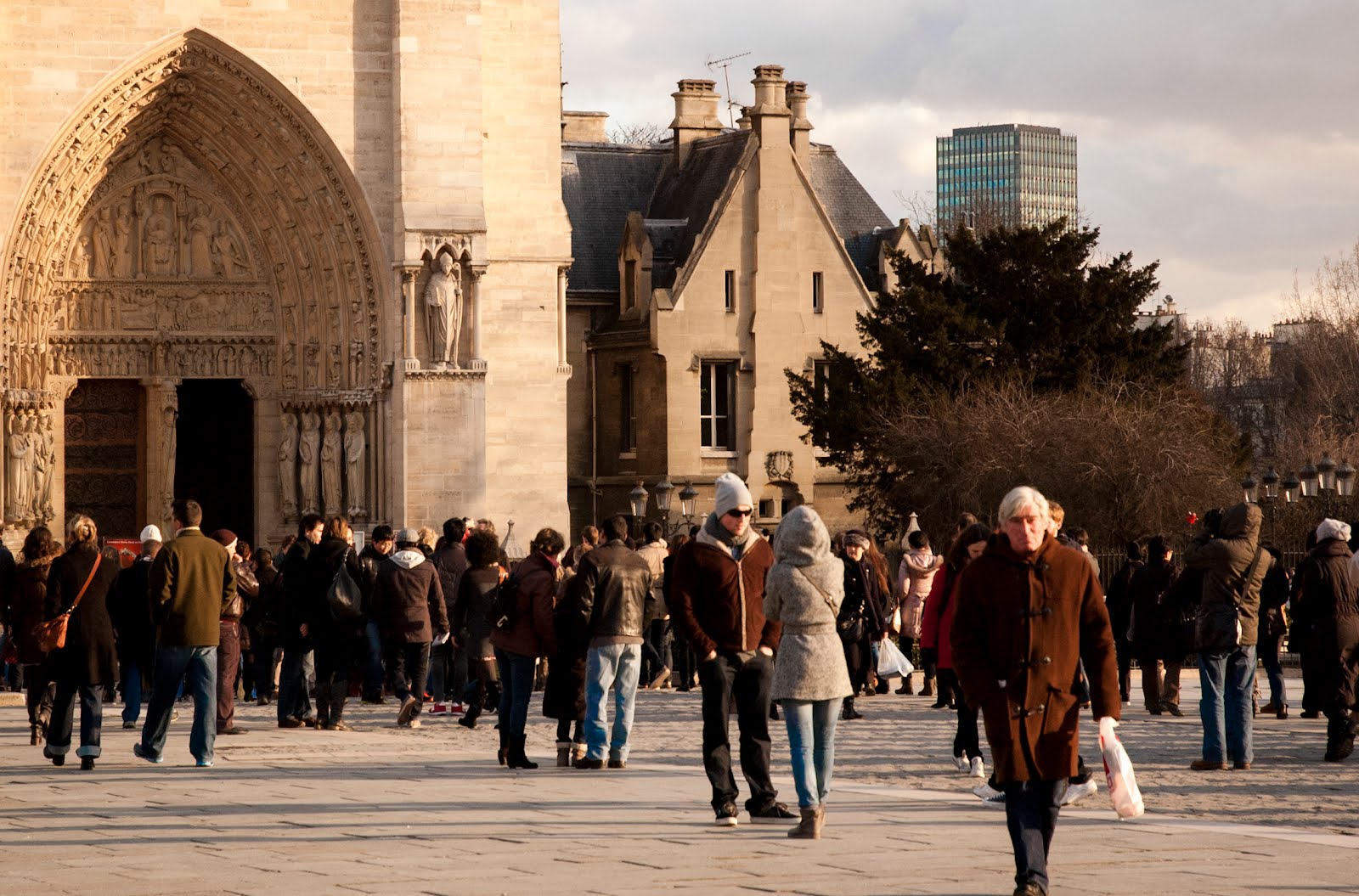
Since my apartment is right in the 3ème arrondissement, these first few days I've spent my time completely within the confines of the old Haussman-edited city. This may explain why upon arrival at the Notre Dame Cathedral, I was first struck by how out of place the shiny tower in the distance looked and only then by the size and detail of the cathedral.

The contrast reminds me a bit of the drama surrounding the building of the Hancock tower in good ol' brick, stone, and concrete Boston, except much more extreme.


Although 'contextual' is often subjective, it would be hard to argue that Notre Dame is not one with its context. Spatially, it is presented to the viewer by the openness around it that is partially afforded by its position within the Seine; it's a development on a whole list of preceding French cathedrals; and it has been a heavily charged political space physically representing the circumstances of the French people.


Wednesday, February 22, 2012

Musée du Louvre

Je ne sais pas pourquoi, mais jusqu'à present, chaque fois que je visite un monument, j'arrive de l'arrière. Au Centre Pompidou, je m'attendais à voir la place. Au Louvre, les pyramides. Mais au lieu de cela, j'ai été accueilli par un champ de métal. Je n'ai aucune d'idée ce que c'est, mais je pense que si je reviens là aprés quelque semains, je savent.

I don't know why, but up till now, every time I go to visit a monument, I arrive from the back. At the Pompidou Center, I was expecting to see the plaza. At the Louvre, the pyramids. But instead, I was greeted by a field of metal. I have no idea what it is, but I figure if I go back in a few weeks, I'll know.


Les pyramides étaient beaucoup plus grands que j'ai prévu, pleine de lumière et l'espace. Pour être à l'extérieur et encore pouvoir faire l'expérience de l'échelle et l'activité du Musée était fantastique. Quand on regarde vers le bas, la vue est plus privilégié q'un vue à travers une façade vertical vitrée, et la hauteur des pyramides apporte l'activité du musée à l'extérieur.

The pyramids were much bigger than I expected, full of light and space. Standing outside and yet being able to experience the scale and activity of the museum was fantastic. Looking down into a space makes for a much more privileged view compared to looking through a glazed vertical facade, and the pyramids sticking up into the space of the plaza effectively brings the activity of the museum to the outside.


Tuesday, February 21, 2012